
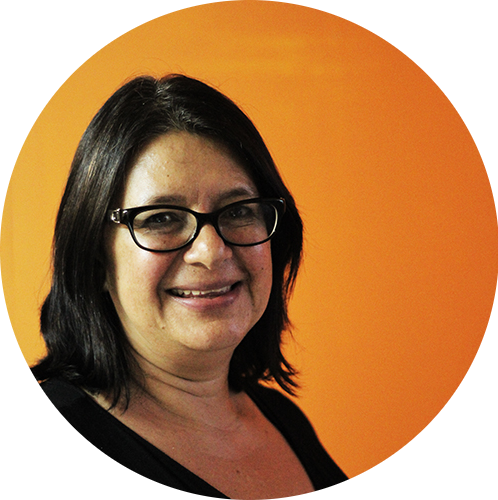
She is one of the pillars of the cooperative. Confidence, joy and precision are among the principles that guide her work as General Coordinator of the Sulá Batsú team. She is a Computer Engineer from the Instituto Tecnológico de Costa Rica and an Anthropologist from the Universidad de Costa Rica. She is pursuing a doctorate in the interdisciplinary program on the information and knowledge society at the Universidad Abierta de Cataluña (Open University of Catalonia). She coordinates the TIC-as Project and conducts other research, for example on the role of ICTs in innovation processes within social organizations and enterprises in Central America. She will soon begin her master’s studies.
SULÁ BATSÚ
The renowned chemist, physicist and Nobel laureate Marie Curie, as well as Hypatia, the Greek philosopher, mathematician and astronomer, or, more recently, Carol Shaw, the first woman video game designer, are some of the female figures featured in one of the campaigns of the Sulá Batsú cooperative. Launched in September 2015, it seeks to highlight the important role that “Women in Science and Technology” have played in the history of humankind.
Based in San José, Costa Rica, the Sula Batsú cooperative aims, among other things, to develop knowledge and skills so that women can play a leading role in technology and other productive initiatives. “Today, men account for 80% of participation in the technology sector, while women make up only 20%,” says Kemly Camacho, one of the members of the Sulá Batsú cooperative.
Within this cooperative, exactly the opposite is true: four men and 16 women work here. But the challenges are not limited to increasing women’s participation; the role they should play is of equal concern. “We do not want them to join merely as a workforce, but to propose how technology should be created in our countries,” Kemly tells La Coperacha.
Sulá Batsú
Sula was the indigenous healer and father of the “earth girl” in the mythology of the Bribri, a culture settled in a region spanning parts of Costa Rica and Panama. Sula is the one who brings the seed and shapes the human being so that it may be born. The word Batsú means hummingbird and refers to the spirit.
Sulá Batsú is made up of professionals from different disciplines; its main work revolves around information technologies, free and open knowledge, culture as a driver of development, and the social and solidarity economy as an alternative for communities .
Self-described as a self-managed cooperative of professionals, Sulá Batsú is committed to remaining rooted in the local, and highlights its sustained activities across different areas for much of the year. Rooted in the deepest cosmogonic meaning of the Bribri, Sula Batsú began its work ten years ago with the aim of sowing the seed of knowledge in communities across Costa Rica.
“It grew out of the interest of professionals who came together to strengthen their capacities, so that our knowledge could blend with local knowledge and local dynamics could be strengthened,” explains Mariana Calvo, one of the members.
Technology and Communities: “Breaking the 80/20”
Information and Communication Technologies, or ICTs, as they are commonly known, are one of the areas in which Sulá Batsú has an impact, naturally with women at the center. One of its most visible projects, whose name alludes to the Costa Rican demonym for women, is TIC-as, a project carried out together with the UN Women Fund for Gender Equality.
This program includes the “Girls and Technology Club”, held at universities and public spaces such as libraries, which encourages girls to use technology to learn about and share local heritage, as well as to reflect on and solve problems in their surroundings.
The “Girls and Technology Club” had only just started when another project was born: the mothers who accompanied their daughters to the club asked whether a club could be created for them while they waited for the girls. The TIC-as project immediately responded by opening the “Mothers and Technology Club”.
The TIC-as Project aims to integrate women into the technology economy by developing leadership among young rural women. “We need the technology economy sector to integrate more women, not as employees, but so that women can have a say in the technology produced in our countries,” explains Kemly.
“It has this economic rights approach, and we have been building a model here; we want people to understand that the integration of women into technology must be addressed comprehensively. It must be addressed with girls, schools, high schools, universities, technology companies, technology chambers, and through public policy and institutions,” she adds.
Social and Solidarity Economy
Although much of their energy is devoted to technology projects with women, they also work in social research, project design, management and monitoring, and the development of methodologies and processes. The so-called Social and Solidarity Economy (SSE) is no stranger to them. “We have been committed to the solidarity economy since our founding; we believe in different redistributive processes,” notes Kemly.
Kemly observes many initiatives within the SSE in Costa Rica that do not identify themselves as part of this sphere. She also explains that Costa Rica is working on a Social and Solidarity Economy Law. “We have institutions and mechanisms that strengthen the whole cooperative sector, but efforts are now being made to broaden this to the social and solidarity economy.”
“Business chambers have found it very hard to accept the reinforcement and strengthening of the social and solidarity economy.”
Casa Batsú: Art and Culture to Reduce Stereotypes
Access to and promotion of culture are an important part of the cooperative’s daily life, largely centered on its cultural space, “Casa Batsú”. Exhibitions of painting, graphic art and comics, film and documentary screenings, music events and even mezcal tastings brought from Mexico all find a place in this multicultural space.
Work from a cultural perspective plays a cross-cutting role in the cooperative’s activities, as shown by the Graffiti contests and the workshops it delivers. “Art is a driver of change, and we try to link it to the rest of our projects. It is a way of reaching communities and energizing technology; we have opened new channels with other youth sectors that we did not have before,” says Mariana.
Sulá Batsú seeks to use “art and culture to reduce stereotypes”. “It has helped us become rooted in the local; people now recognize us for this, and they know that social transformation happens here,” Kemly says proudly.