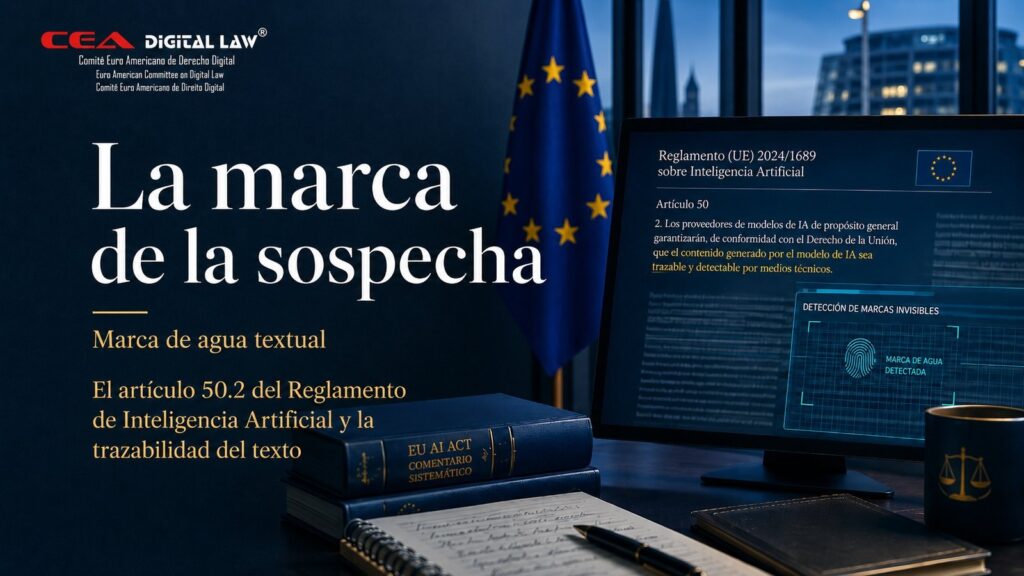
CEA Digital Law is an academic and research organisation specialising in digital law, with a reach spanning Europe and the Americas. Its audience is made up of legal experts, regulators, academics and companies seeking advice on digital regulation.
1. Legal professionals and digital law experts
Profile: Lawyers specialising in digital law, judges, prosecutors and regulators.
Age: 30–65.
Location: Europe and Latin America.
Needs:
 Keeping up to date with legislation such as the GDPR, the Digital Services Act (DSA), the Digital Markets Act (DMA) and other international regulations. Understanding the impact of artificial intelligence and cybersecurity on the law. Accessing academic publications and taking part in legal discussion forums.
Pain points:
 A lack of clear information on how digital law is evolving in different countries. The complexity of interpreting and applying new regulations. The need for continuous training to stay competitive in the sector.
2. Technology companies and in-house legal departments
Profile: Heads of legal, compliance officers and legal advisers at technology companies.
Age: 35–60.
Location: Europe, Latin America and the US.
Needs:
Advice on digital regulatory compliance to avoid penalties. Understanding the legal impact of artificial intelligence and data protection. Access to research on digital law and regulatory trends.Pain points:
Uncertainty about how to adapt their business models to digital regulation. Exposure to legal risks owing to a lack of specialist knowledge. The need to train their teams in digital regulation and compliance.3. Governments, regulators and international organisations
Profile: Legislators, telecoms regulators, data protection authorities and diplomats.
Age: 40–65.
Location: Europe and Latin America.
Needs:
Access to comparative studies of digital legislation across jurisdictions. Collaborating with digital law experts to design new regulations. Attending international conferences and events on digital governance.Pain points:
The lack of a uniform global legal framework for digital law. Challenges in regulating digital platforms and data protection. The need for cooperation between countries to harmonise technology regulation.4. Academics and researchers in digital law
Profile: University lecturers, researchers and postgraduate students in digital law and technology.
Age: 25–65.
Location: Global.
Needs:
Accessing scientific publications and taking part in academic conferences. Publishing research in prestigious journals. Connecting with other digital law experts.Pain points:
A lack of academic networks specialising in digital law. Difficulty finding up-to-date sources of information. A shortage of advanced training in some regions.CEA Digital Law positions itself as a leading centre for digital law, offering research, advice and forums for discussion to experts, companies and regulators.
Examples
CEA Digital Law is a benchmark in the field of digital law, providing advice and specialist knowledge on international regulations. Below are realistic scenarios that represent each type of audience and show how CEA Digital Law meets their needs.
1. Legal professionals and digital law experts
María is a lawyer with 15 years’ experience in corporate law. In recent years, she has noticed that digital regulation has changed radically, and her clients, who operate in e-commerce and digital services, increasingly expect her to advise them on data protection, cybersecurity and artificial intelligence regulation.
She knows she cannot afford to fall behind. She needs up-to-date training and access to high-level legal analysis. However, the information available is confusing and often fragmented.
When she discovers CEA Digital Law, she finds a space where she can:
Access detailed research on digital law in Europe and the Americas. Take part in forums with other experts and share knowledge. Attend events that analyse the latest technology regulations.María now has a competitive edge: her specialist knowledge allows her to position herself as a digital law expert and to advise her clients with complete confidence.
2. Technology companies and in-house legal departments
Luis is head of legal at a fintech company operating in several Latin American countries. His company handles personal data, complies with financial regulations and is in the midst of expanding into Europe. But there is a problem: the rules differ from one jurisdiction to the next, and a single mistake could cost the company fines running into the millions.
Every time he analyses legislation such as the GDPR in Europe or the new artificial intelligence laws, he runs into obstacles:
The information is dense and hard to apply to his business. He has no access to experts who can give him practical guidance. Regulatory changes are constant and hard to keep up with.Luis decides to get in touch with CEA Digital Law and finds exactly what he needs:
Specialist reports explaining the impact of regulation on the fintech sector. Access to consultants and academics who help him design compliance strategies. Events where large companies share their experience of regulatory compliance.Thanks to this partnership, Luis can anticipate regulatory changes and ensure that his company complies with digital regulations without compromising its growth.
3. Governments, regulators and international organisations
Ana is an adviser at a government agency responsible for regulating digital platforms. Her team is working on a bill to safeguard citizens’ privacy online, but there is a challenge: each country has its own model, and there is no uniform framework to use as a reference.
She knows she needs reliable, comparative information to design effective legislation, but she faces several problems:
Digital regulation is a new and constantly evolving field. There are not enough studies on the impact of regulation in different countries. The lack of international cooperation makes it hard to create global standards.By connecting with CEA Digital Law, Ana gains access to an ecosystem of knowledge:
Comparative research on digital legislation in Europe and the Americas. Contact with regulatory experts who have worked on drafting similar laws. International conferences where legislators and regulators debate the evolution of digital law.With this support, her team succeeds in drafting a bill based on global best practice, avoiding mistakes that could have delayed its implementation.
4. Academics and researchers in digital law
Pablo is a law lecturer at a Latin American university and has spent years researching the regulation of artificial intelligence. However, he has noticed that the academic literature in this area is still limited, and that it is hard to find studies examining the impact of digital regulation from a comparative perspective.
He knows that, for his research to have an impact, he needs visibility in the international legal community and access to networks of experts with whom he can share findings and debate ideas.
On joining CEA Digital Law, Pablo finds a space where he can:
Publish his studies in specialist journals with an international reach. Connect with academics in Europe and the Americas who work in the same field. Take part in conferences where regulators and companies take his research into account.His work no longer stays within academia: it is beginning to influence public policymaking and the development of innovative regulatory frameworks.
These scenarios show how CEA Digital Law is a key pillar in the development of digital law in all its dimensions.
Newsletter
Events, news and analysis on digital law, straight to your inbox. Only when we have something worth telling you.