
In brief
- Kenya and the European Union concluded their Digital Dialogue in Brussels on 23 and 24 November 2026 with a joint communiqué and a roadmap.
- Technical negotiations on mutual data adequacy are complete, but formal adoption is still pending.
- The package covers fibre, €10 million for AI cooperation, digital identity and child online protection.
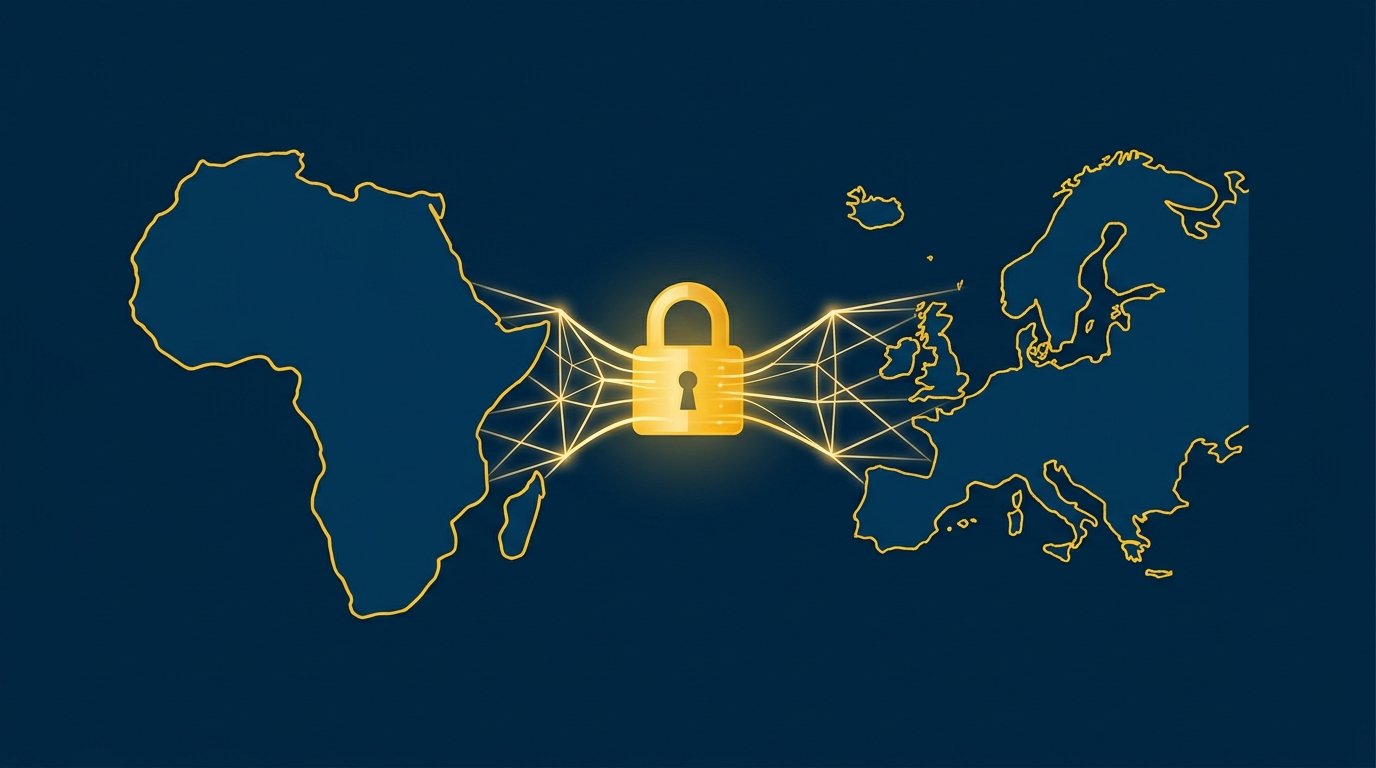
Kenya and the European Union have concluded their Digital Dialogue in Brussels with a joint communiqué and a cooperation roadmap, as reported by TechTrendsKE. For digital law, the key point is that technical negotiations on mutual data adequacy are complete.
What was agreed
The talks took place on 23 and 24 November 2026. Kenya was represented by John Tanui, Principal Secretary for ICT and the Digital Economy, and its ambassador to the EU, Joash Maangi. The European Commission side was led by deputy directors-general Renate Nikolay (DG CONNECT) and Myriam Ferran (DG INTPA). The roadmap covers digital infrastructure, artificial intelligence, data protection, digital public infrastructure and online safety. Kenya became the first African country to establish a formal Digital Dialogue with the EU in March 2026.
Infrastructure and AI
The Team Europe investment pipeline, which pools funding from the EU, its member states and their development finance institutions, includes 3,000 km of aerial fibre, connectivity for 3,000 schools, health centres and digital hubs, and Wi-Fi for 400 remote communities. Extending the Blue Raman subsea cable to Kenya and Tanzania is also under discussion.
On AI, the EU will commit €10 million to partnerships with the European AI Factories, starting with language diversity and agriculture. Both sides are also exploring an open-access AI compute facility in Kenya for startups, SMEs and researchers.
Data, identity and children
According to Tanui, once adopted, mutual adequacy would be the first arrangement of its kind between the EU and an African country. An adequacy decision recognises that each side’s data protection rules offer equivalent protection, so personal data can flow without additional safeguards. It is worth stressing that, for now, technical negotiations are finished, but no decision has been adopted.
The roadmap also covers trusted digital identity, including interoperability with the EU Digital Identity Wallet, child protection online, the Digital Product Passport, and a partnership between the European DIGITAL SME Alliance and the Digital Transformation Centre Kenya to boost digital services exports and BPO jobs.
Our view at CEA Digital Law
For the Euro-American Committee of Digital Law - CEA Digital Law, this is a useful reference for the continent. Reciprocal adequacy places Kenya as an equal regulatory counterpart rather than a rule-taker. For other African and Latin American and Caribbean countries, the lesson is that adequacy rests on years of legal framework, an operational supervisory authority and institutional trust, and works best alongside investment in connectivity and skills.
Open questions deserve follow-up: the timetable for adoption on both sides, how equivalence will be monitored over time, and how data flows will interact with shared AI infrastructure. We encourage the process to be documented transparently so that it can serve as a replicable model for agreements between Europe, Africa and Latin America and the Caribbean.
Sources
CEA Digital Law
Newsletter
Events, news and analysis on digital law, straight to your inbox. Only when we have something worth telling you.
Membership
Join the Euro-American Committee of Digital Law - CEA Digital Law
An international community distinguished by the professional excellence of its members. Membership involves no fees or costs of any kind: what unites us is research and the aims of an international non-profit organisation.
Publish with us
Write for Tribuna Atlántica
Tribuna Atlántica. Pensamiento Contemporáneo, the international publication of CEA Digital Law, opens its pages to those who bring knowledge, professional experience, research or reflection to help understand our times. It seeks an original perspective, grounded in rigour and sound sources, from different disciplines and regions.