
Antonio Tejeda Encinas, Lawyer. CEO, Meta Channel Corp. President of the Euro-American Committee of Digital Law - CEA Digital Law
Comparative analysis: Regulation of deepfakes and manipulated content at the UN and in the European Union
UN documents and rules: The UN has addressed the problem of deepfakes and disinformation through a number of documents and recommendations, most notably the report of the 2024 AI for Good Global Summit and UNESCO’s Recommendation on the Ethics of Artificial Intelligence, adopted in 2021 and updated in September 2024. The UNESCO Recommendation is the first global ethical framework applicable to its 194 Member States, and it focuses on transparency and on protecting human rights against manipulated content and deepfakes.
In addition, the UN has published its Guidelines for the Governance of Digital Platforms, with a specific focus on content moderation and the protection of freedom of expression. The guidelines seek to set standards on how to regulate manipulated information, prevent harm to society and ensure that digital platforms operate transparently and responsibly.
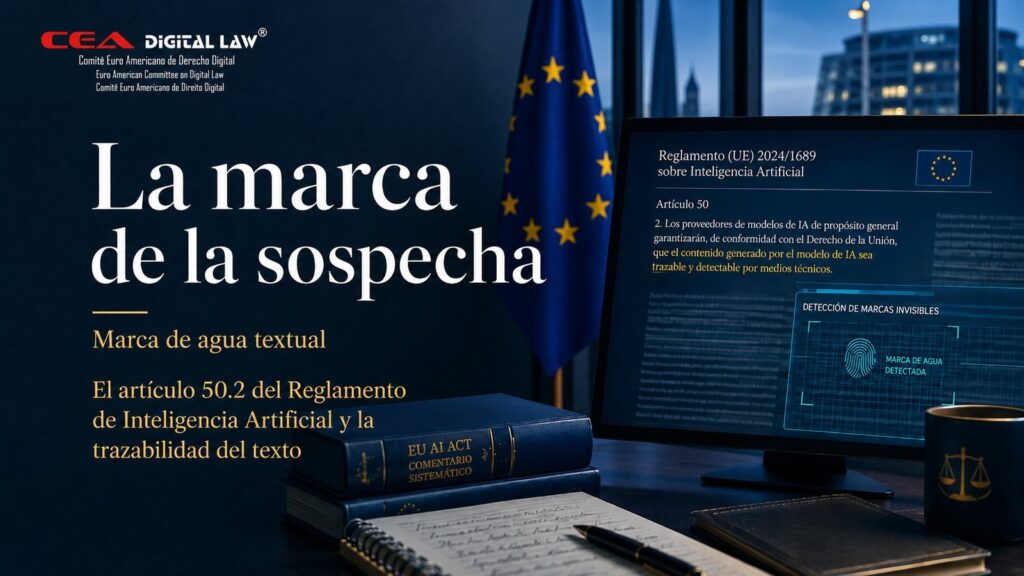
On a more technical level, the International Telecommunication Union (ITU) has released the paper ‘AI Watermarking: A Watershed for Multimedia Authenticity’, which sets out standards for the use of watermarking and deepfake detection technologies. Presented in May 2024, the report proposes technical solutions for tracing the provenance of AI-generated content and mitigating the risks of disinformation.
The European Union’s approach: the AI Act and the Code of Practice: The European Union has opted for a more structured regulatory approach with the EU Artificial Intelligence Act (Regulation (EU) 2024/1689), which entered into force in August 2024. The regulation classifies AI systems according to their level of risk and lays down specific obligations for manipulated content and deepfakes. AI applications that generate deepfakes are classified as high-risk, which requires providers to include clear provenance labels and to ensure that their systems are transparent.
The AI Act also directly prohibits certain uses, such as deepfakes used for political or social manipulation, treating them as ‘unacceptable risks’ that cannot be allowed within EU territory. In April 2025 the legislation will be supplemented by the Code of Practice for providers of general-purpose AI (GPAI) models, which will provide ethical and technical guidelines for building these models, although adherence will be voluntary.
The extraterritorial reach of the AI Act: Although the AI Act applies directly in the EU Member States, its extraterritorial reach has global implications. Any company outside the EU that wishes to operate in the European market or process the data of European citizens must comply with these rules. This means that companies in Latin America, the US and Asia will have to adapt to these standards if they want to offer services in Europe. The result is a domino effect, influencing how other regions and countries develop their own AI regulations.
Other international projects: Other global governance efforts are also under way, such as the UN’s work on a Cybercrime Treaty, which seeks to create a legal framework to combat cybercrime and protect societies from the malicious use of deepfakes. Although the process has been controversial and has drawn criticism for the lack of consensus, it represents an effort to secure a binding global agreement.
A future of integrated rules: The UN’s approach is based on global cooperation and on creating technical and ethical standards applicable to all its members, ranging from ethics and digital governance to the technical detection of deepfakes. The European Union, for its part, is implementing a more specific and mandatory regulatory framework through its AI Act, which allows it to act quickly within its territory and to set global precedents.
While the EU focuses on immediate implementation and the protection of fundamental rights, the UN offers a more holistic perspective that can be adapted to different contexts. Ultimately, cooperation between the two frameworks will be essential to establish a global standard that protects societies from the risks of deepfakes and other malicious uses of generative AI.
Newsletter
Events, news and analysis on digital law, straight to your inbox. Only when we have something worth telling you.