In brief
- Portugal's Government is preparing a new Código da Comunicação Social, due by the end of 2026, and a legislative proposal for arbitration between media and AI platforms.
- The State AI model Amália will serve as a testbed for paying for access to journalistic content.
- A Fundo de Apoio à Modernização e Digitalização dos Media is also planned, along with a cut of about 90% in Lusa's prices from January 2027.
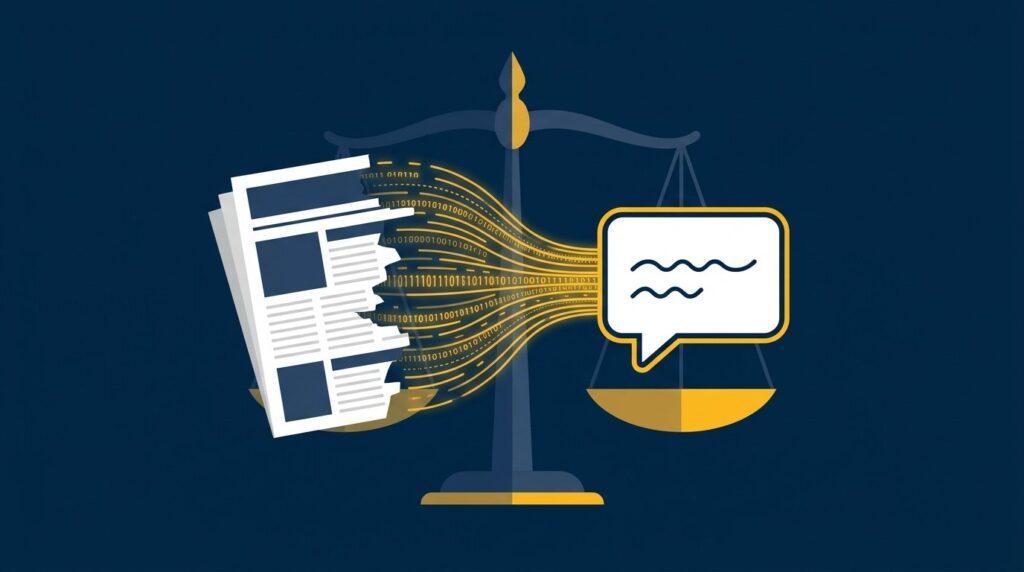
Portugal’s Government has announced that it is working on a new Código da Comunicação Social (Media Code) and a legislative proposal for an arbitration mechanism to regulate access by artificial intelligence (AI) platforms to journalistic content and ensure fair payment to news outlets. The Government portal reported it on 6 November 2026. It matters because it brings the debate over who benefits from the use of news to train and feed AI models into the regulatory arena.
What has been announced
The announcement was made by the Ministro da Presidência, António Leitão Amaro, on 4 November in Lisbon, at the “Futuro dos Media” conference. According to the Government, the sector faces an “existential challenge”, aggravated by AI and by the role of large platforms in distributing information.
The main measures are:
- New Código da Comunicação Social: completion is expected by the end of 2026. It aims to modernise the legislation, reduce restrictions and level competition between media and platforms, and includes a review of advertising rules, including targeted advertising.
- Arbitration mechanism: the legislative proposal is due to be presented this year. It would also cover media archives and databases. The State AI model, Amália, will be used to test the payment scheme.
- Fundo de Apoio à Modernização e Digitalização dos Media: mainly publicly funded, with governance meant to protect independence from political power.
- Public service and self-regulation: investment in RTP and Lusa, a cut of around 90% in Lusa’s prices for media outlets from January 2027, and up to two million euros for professional self-regulation.
What is still only an announcement
It is worth separating the levels: no legislative text has yet been published or approved. These are political intentions and timetables. The Minister also rejected creating official mechanisms to define “truth” in the fight against disinformation, favouring editorial independence and public scrutiny.
Our view at CEA Digital Law
At the Euro-American Committee of Digital Law - CEA Digital Law, we welcome the Portuguese Government’s choice of arbitration rather than prohibition alone: it can reduce the imbalance in bargaining power between publishers and large platforms without endless litigation. Several questions remain open:
- Fit with EU law: the press publishers’ right in Directive (EU) 2019/790 and the rules on text and data mining already govern part of this ground. A national mechanism will need to sit alongside them and the AI Act without fragmenting the internal market.
- Scope and criteria: which platforms would be covered, how a “fair” value would be set, how independent the arbitrator would be, and how money would be shared between large and small outlets, and with journalists.
- Independence: if the fund is mainly publicly financed, transparent governance and criteria will be the real safeguard of pluralism.
- Testing with a public model: using Amália as a testbed is an interesting and replicable idea, provided results and conditions are published.
For Latin America and the Caribbean and for Africa, where several countries are discussing how to compensate local media against platforms, the Portuguese experience could be a useful case: public arbitration, with transparency and proportionality, that neither closes access to information nor slows local innovation.
Sources
CEA Digital Law
Boletim
Eventos, notícias e análises sobre direito digital, no seu e-mail. Só quando houver novidades.