In brief
- On 3 November 2026, Advocate General Maciej Szpunar delivered his Opinion in Case C-250/25 Like Company, the first generative AI case before the CJEU.
- He proposes that LLM training is, as a rule, covered by the text and data mining exception, while real-time reuse of press content by a chatbot may infringe the publisher's right.
- The Opinion is not binding on the Court of Justice, which will rule at a later date.
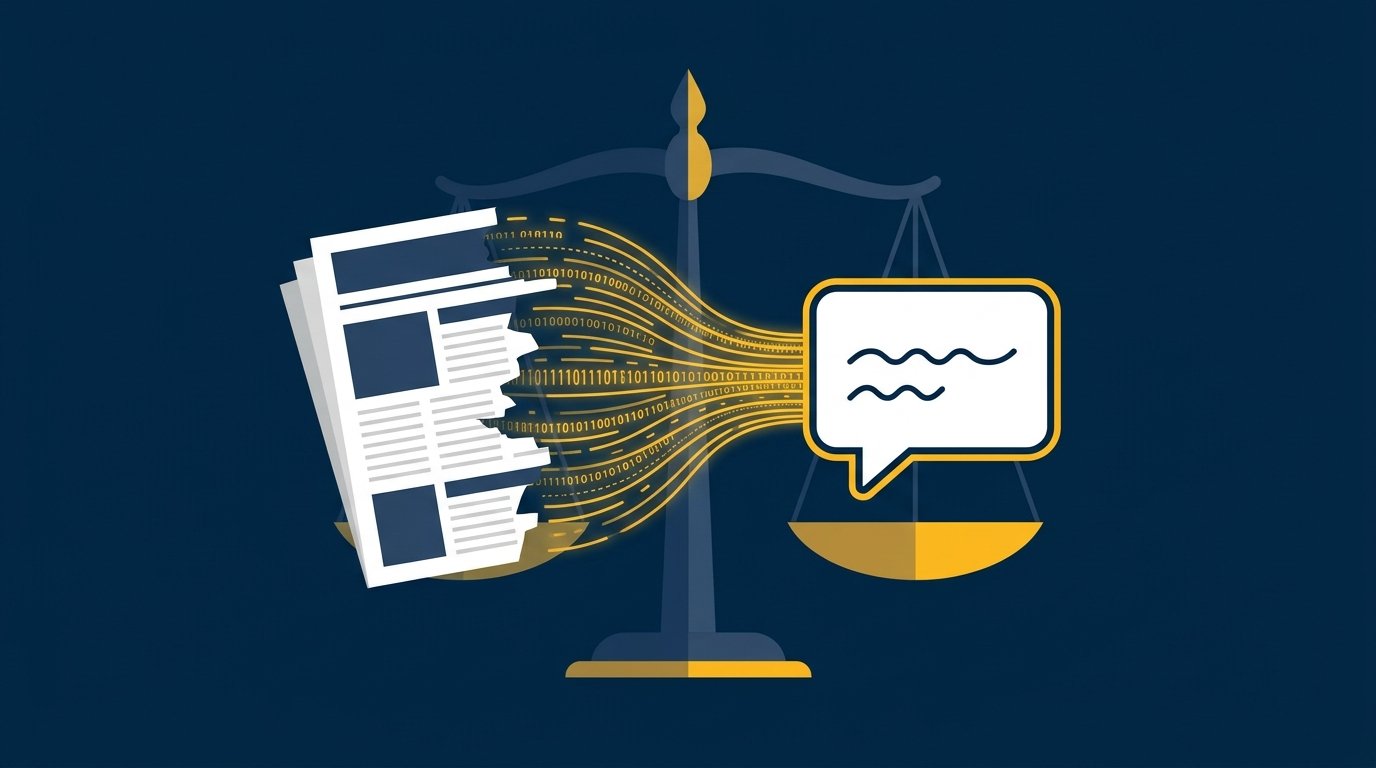
On 3 November 2026, Advocate General Maciej Szpunar delivered his Opinion in Case C-250/25, Like Company, the first generative AI case to reach the Court of Justice of the European Union. It matters because it sets out when a chatbot that retrieves and reuses online press may infringe publishers’ rights.
The case
Like Company, a Hungarian operator of web portals, sued Google Ireland Ltd. before the Budapest Regional Court (Hungary). It relies on the press publishers’ related right over online use of their publications (Article 15(1) of Directive (EU) 2019/790 on copyright in the Digital Single Market). It argues that Google used its articles to train the Gemini language models and, between 13 June 2023 and 31 May 2024, reproduced them and made them available to the public through the chatbot. The Hungarian court referred four questions: two on training and two on the chatbot’s answers.
What the Advocate General proposes
On training, he advises that both questions be declared inadmissible: there is no evidence the claimant’s articles were used, and training is not an “online use” of press publications. For completeness, he suggests that training a model on protected material is, as a rule, freely permitted under the text and data mining exception (Article 4 of the same Directive).
On the answers, which matter for the dispute, he stresses that the publisher’s right protects the specific form of expression, not the facts reported. For the reproduction right, two factors count: whether the chatbot gained access unlawfully (for instance by circumventing effective technical measures such as a paywall) and whether the answer merely reports facts or reuses the form of expression recognisably, so that the user need not consult the original. The right of making available to the public is, as a rule, infringed where that form of expression is systematically recognisable in answers to related queries.
Finally, the provider would be liable where such uses are inherent to its business model or where it has failed to put in place appropriate measures to counter them credibly and effectively. The Opinion is not binding; the judges are now deliberating and judgment will follow at a later date.
Our view at CEA Digital Law
The Euro-American Committee of Digital Law - CEA Digital Law welcomes an approach that avoids two extremes: no monopoly over the news, but no free pass to substitute the original outlet. The distinction between facts and form of expression is a practical yardstick that courts and companies beyond the EU can use.
For Spain and Portugal, which transposed the Directive, the final judgment will be a direct reference. In Latin America and the Caribbean, where the remuneration of media by platforms and AI systems is under debate, the test of lawful access and recognisable reuse offers a transferable criterion without immediate legislative reform. In Africa, where media markets can be fragile, it shows how journalistic investment can be protected without closing the door to innovation.
Open questions remain: how “recognisability” will be measured, which measures will count as “credible and effective”, and how unlawful access will be proven. We suggest that publishers document their technical protections and that developers build verifiable controls into their systems while awaiting the Court’s ruling.
Sources
CEA Digital Law
Boletim
Eventos, notícias e análises sobre direito digital, no seu e-mail. Só quando houver novidades.