
Blockchain-based financing opens up a range of innovative opportunities for raising funds and creating cutting-edge financial services.
Two players stand out in this field: STOs (security token offerings) and DeFi (decentralised finance) protocols.
Although both are built on the same blockchain technology, the two approaches differ markedly in how they operate, the regulations that apply to them, the obstacles they must overcome and the risks inherent in them.
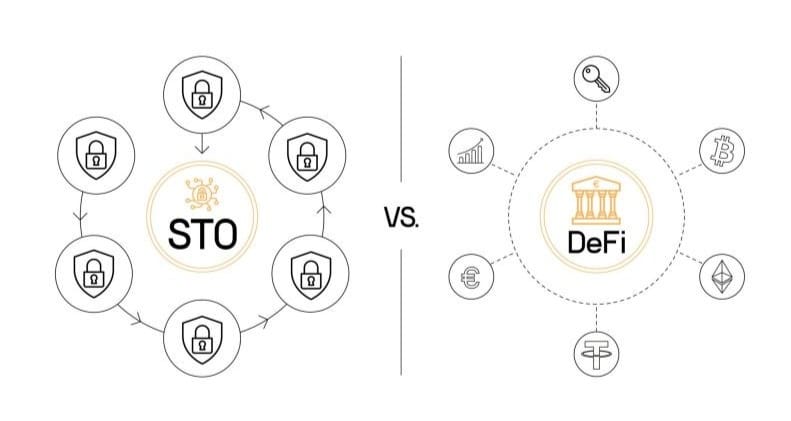
STOs enable companies to issue security tokens backed by financial assets such as shares, bonds or real estate. Through digital tokens, this mechanism makes it possible to invest in fractions of landmark buildings or in stakes in promising companies. Launching an STO begins with the issuance of these security tokens, which investors can buy with either fiat currency or cryptocurrency. The intriguing part is that every transaction involving these tokens is recorded and executed on a blockchain, providing transparency and traceability at every stage. It is important to bear in mind, however, that carrying out an STO means complying with the financial regulations in force.
DeFi protocols, on the other hand, operate in a fully decentralised environment with no intermediaries, offering an alternative to STOs. These protocols use smart contracts on the blockchain to automate a wide range of financial transactions, including lending, exchanges and the generation of passive income. Their distinguishing feature is their decentralised approach. Users interact directly with smart contracts through their digital wallets, which gives them access to financial services without relying on traditional intermediaries such as banks or stockbrokers. Unlike STOs, most DeFi protocols are not subject to established financial regulation.
It is worth noting that the DeFi community has introduced measures to mitigate the inherent technical and security risks, including security audits by experts, the use of reliable oracles to obtain external information and the adoption of cybersecurity best practices, all with the aim of protecting users’ assets and data.
Newsletter
Events, news and analysis on digital law, straight to your inbox. Only when we have something worth telling you.