Submitted by the General Codification Commission (Comisión General de Codificación, CGC) to the Ministry of Justice. So far, the drawbacks outweigh the merits!
Antonio Tejeda Encinas, former Secretary General of the Inter-American Academy of International and Comparative Law (Havana, 1941)
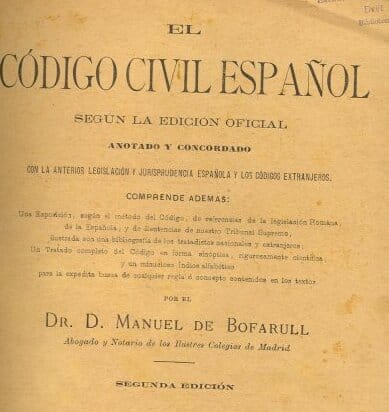
This is a proposal to update, rather than modernise, the ‘Código Civil’ (Spanish Civil Code) in the area of obligations and contracts. Clearly, the CGC has responded to whatever mandate the Ministry of Justice gave it: the Common Frame of Reference, the proposed Regulation on a Common European Sales Law and certain Directives awaiting transposition.
What it does not address:
There are no rules on consumers.
There is no provision whatsoever on smart contracts, distributed ledgers or digital assets. Why not take advantage of the reform?
If we want a genuinely modernising reform,
should we not give special treatment to smart contracts;
to contracting;
and to the use of electronic ledgers;
or to the duties and liabilities of oracles?
Should we not recognise electronic ledgers, or determine the effects of tokenisation, if only under the law of obligations? This is already in the Swiss Civil Code, and bills are going through the legislative process in other comparable jurisdictions, such as the UK. Why not genuinely modernise the law of obligations and contracts?
In 2009, the General Codification Commission submitted a proposal to modernise Titles I and II of Book IV of the Civil Code, which have remained practically unchanged since they were first drafted in 1889. The process took into account various international texts, such as the Vienna Convention on Contracts for the International Sale of Goods, as well as the Principles of European Contract Law and the UNIDROIT Principles of International Commercial Contracts, drawn up by various supranational bodies.
Lettre d’information
Événements, actualités et analyses sur le droit numérique, dans votre boîte de réception. Seulement quand il y a quelque chose à dire.