Antonio Tejeda Encinas | President of the Euro-American Committee of Digital Law - CEA Digital Law | CEO of META Channel Corporation
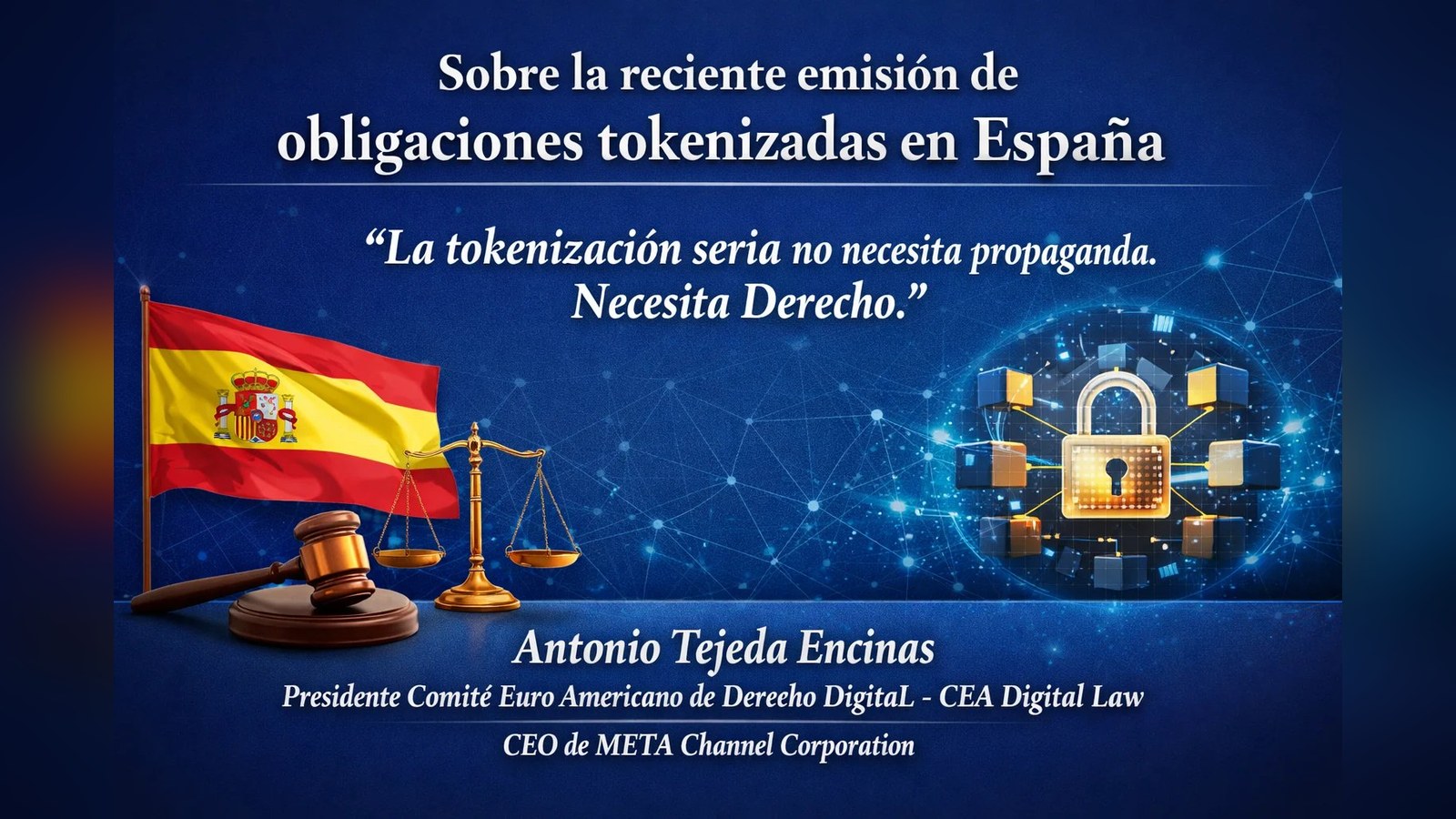
The recent issue of tokenised non-convertible bonds by OTESA SPV CAL S.L., structured through formal registration and DLT-based recording, deserves to be taken seriously. Not because it closes the debate, but precisely because it forces us to raise its level. This is no longer an academic hypothesis or a piece of commercial theatre wrapped in technological jargon. It is a real transaction that demonstrates the capacity to execute within the Spanish legal system. And that is precisely why both routine scepticism and premature euphoria should be avoided.
The first thing to clean up is the language. What has been tokenised here is not the share capital of a limited company. What has been structured is a debt issue of non-convertible bonds within a special purpose vehicle. That distinction is not secondary. It is what separates serious analysis from ecosystem noise. Tokenising debt is legally far more workable than achieving a full, robust and settled representation of the shares (participaciones) of a Spanish limited company. That is why this precedent has value. But it gives no licence to pretend to a systemic maturity that does not yet exist.
The underlying question is not whether the technology works or whether certain operators have managed to close the structure. That has already been shown. The question lies elsewhere: whether the Spanish legal system has yet reached a degree of coherence sufficient for these transactions to stop depending on an intensively assisted architecture and become a standardised, replicable and secure basis for financing. My answer is clear: not yet.
Law 6/2023 has enabled real progress. It has opened the door to representing transferable securities through systems based on distributed ledger technology and has given a legal footing to the entity responsible for entry and registration. That matters, and it would be absurd to deny it. But opening the door is not the same as finishing the building. The financial and regulatory side has moved faster than the full resolution of the corporate, registry and insolvency implications of these structures. And as long as that asymmetry persists, each successful transaction will be both a confirmation and a warning.
A confirmation, because it shows that we are no longer in the realm of rhetorical experiment. A warning, because it shows how far we still depend on an especially finely tuned combination of legislation, technological infrastructure, platform governance, issue documentation and registry architecture. That is not yet legal normality in the strong sense. It is qualified operational feasibility. It has merit, certainly. But merit should not be confused with consolidation.
The main problem is not technological. Nor is it a market problem. There is enough technology and there are capable operators. The problem remains legal and institutional. The regulatory framework has not been closed. What is missing is a more coherent integration of securities market law, the Spanish Companies Act (TRLSC) and the handling of disputes once the transaction moves beyond issue and into the real life of the instrument: transfer, enforceability against third parties, exercise of rights, technical incidents, possible defaults and insolvency scenarios. That is where the robustness of the system is truly measured. Not when the milestone is announced, but when the instrument has to survive a dispute.
Moreover, when these structures are connected to crowdfunding platforms, the requirements do not diminish; they increase. The sophistication of the infrastructure sits alongside the need to protect investors properly, since they do not always have the same capacity to read the legal or technological detail. Tokenisation can bring traceability, granularity and efficiency. It can also introduce new dependencies in technical governance, allocation of liability and operational robustness. Presenting all of this as if it were already fully settled would be selling a maturity that the system has not yet reached.
From a broader perspective, this is not just a debate about one specific transaction or how well its promoters have judged it. It is a debate about the kind of legal infrastructure Spain wants to offer in the transition to tokenised financial markets. And here the decisive question is not whether a one-off precedent can be executed, but whether there is already a regulatory and institutional architecture capable of sustaining a practice that is scalable, consistent and defensible under stress. That is the real test of maturity. Not the first eye-catching transaction, but the system’s ability to absorb the second, the tenth or the hundredth without having to reinvent the legal fit each time.
That is why I do not share the complacency with which some present milestones of this kind as if they already amounted to a general, mature tokenisation of the system. The milestone is real and deserves recognition. But what it shows is not that corporate and financial tokenisation in Spain has reached a stage of full consolidation. What it shows is something more sober and more demanding: that Spain can now execute these transactions, but is still doing so on ground where legal certainty depends too heavily on carefully designed structures rather than on a fully established institutional normality.
That is the point that matters. Not whether it can be done, but whether we decide to build the law needed for it to be done at scale, with consistency, predictability and genuine market value. Until that task is complete, we will go on having valuable precedents, but not yet a mature infrastructure.
Acknowledging this does not weaken the progress made. It protects it. Because serious tokenisation does not need propaganda. It needs law.
النشرة
فعاليات وأخبار وتحليلات في القانون الرقمي تصلك على بريدك، ولا نراسلك إلا حين يكون لدينا جديد.